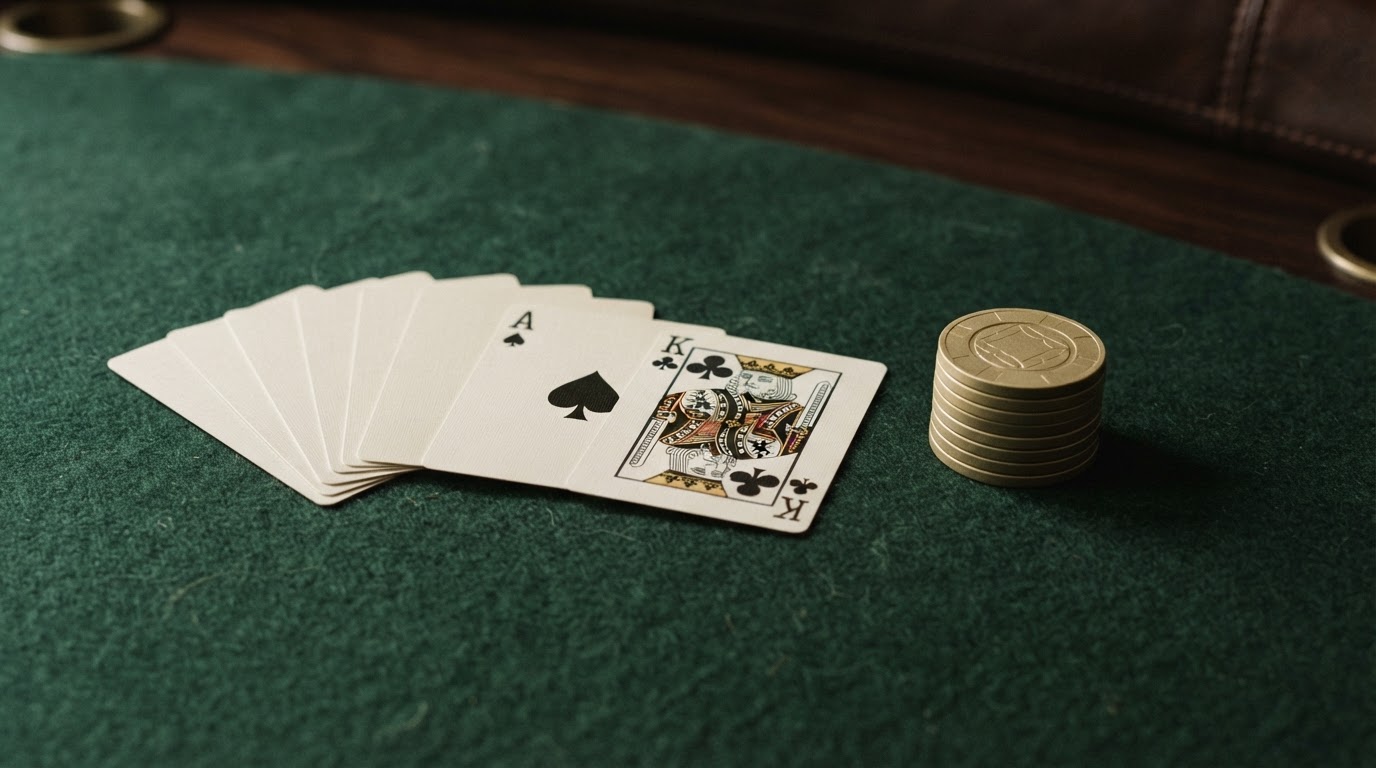

In Texas hold'em, two private cards meet five shared cards. Every player still in the hand builds the best possible five-card poker hand from the seven cards available to them. You can use both private cards, one of them or neither.
That last detail explains many surprising split pots. A beautiful starting hand does not remain special just because it looked strong before the flop. At showdown, only the best final five-card combination counts.
This guide concerns ordinary high-hand Texas hold'em, not casino games that borrow the name while having you compete against a dealer.
The button and the blinds
The dealer button marks a position that moves around the table. In a normal game with three or more players, the next two positions post the small and big blinds. These forced bets create a pot before anyone chooses to enter the hand.
With blinds of £1 and £2, a player who has posted nothing must put in £2 to call the big blind. The small blind normally needs another £1 to call if no one raises. The big blind already has £2 committed but still gets an opportunity to act when the betting reaches that position.
Heads-up play uses a different arrangement: the button posts the small blind and acts first before the flop, then last on later betting rounds. A beginner should check which structure is actually being used.
Four rounds of betting
After everyone receives two private cards, the first betting round takes place. This is pre-flop. The dealer then reveals three community cards together, called the flop. Another betting round follows.
One more shared card, the turn, creates the third betting round. The final shared card is the river, followed by the last round of betting. If more than one player remains, their hands are compared at showdown.
A hand can finish before any of those later stages. If every opponent folds, the remaining player wins the pot without having to make the highest possible hand on an imaginary future board. Folded cards have surrendered their claim to that pot.
Check, bet, call, raise or fold
Checking passes the action without adding money when there is no outstanding bet to match. Betting introduces a wager on the current round. Calling matches the amount required to stay in. Raising increases that amount, while folding abandons the hand.
Suppose nobody has bet on the flop. One player checks and another bets £6. When action returns, the first player cannot simply check again: there is now a bet to call, raise or fold to.
In no-limit hold'em, a permitted bet can involve a player's remaining stack. Minimum-raise rules still apply. A short all-in can create special situations about whether betting reopens, so ask the dealer or consult the house rules instead of assuming every increase permits another raise.
Reading the hand rankings
From strongest to weakest, the usual categories are straight flush, four of a kind, full house, flush, straight, three of a kind, two pair, one pair and high card. A royal flush is the highest straight flush: ten through ace in the same suit.
A flush needs five cards of one suit. A straight needs five consecutive ranks. An ace can be high in ten-jack-queen-king-ace or low in ace-two-three-four-five, but cannot wrap around the sequence. Queen-king-ace-two-three is not a straight.
Suits do not break ordinary hold'em hand ties. A heart flush does not defeat a club flush merely because hearts look more important. Compare the relevant ranks.
Why the fifth card matters
Imagine both players have a pair of queens. One can make queen-queen-ace-nine-four, while the other makes queen-queen-king-jack-ten. The ace kicker beats the king kicker, despite the second hand having stronger lower cards.
Now imagine the board is ace-king-queen-jack-ten with no flush possible. Both players may use the board's straight. A private pair of aces does not turn that into three aces plus a straight; the hand must contain exactly five cards, and the straight is already stronger than three of a kind.
For two pair, compare the higher pair first, then the lower pair, then the fifth card. For a full house, compare the three-of-a-kind rank before the pair. Working in that order avoids many mistakes.
All-ins and side pots
An all-in player can remain eligible for the money they have matched without having to match further bets. Additional contributions from other players form a side pot.
For example, three players each contribute £30. One has no chips left. The other two later contribute another £20 each. The main pot contains £90 and the side pot £40, before any applicable rake. The short-stacked player can win the main pot but cannot win money they did not match in the side pot.
Separate pots can have different winners. The strongest hand overall does not automatically collect every chip if that player was eligible only for the main pot.
Cash games, tournaments and costs
In a cash game, chips represent money at the table's stated value. In a tournament, chips usually represent progress within the event rather than an amount you can cash out whenever you wish. Entry fees, blind levels, payout structures and re-entry rules need separate reading.
Poker against other players also differs from a house-banked casino game. The operator may charge rake or tournament fees, while results depend on opponents, decisions and chance. Skill does not remove uncertainty or make the game a dependable income source.
A simple learning exercise is to deal five community cards and two private hands, then write down each best five-card combination. Resolve the rankings before considering betting tactics. It is possible to learn the rules accurately without risking money.